Leaders · Diplomats · Commanders · Crews
People and
decisions.
The crisis was shaped by people with different responsibilities, incomplete information and very little time. Explore their roles and the evidence of their involvement.
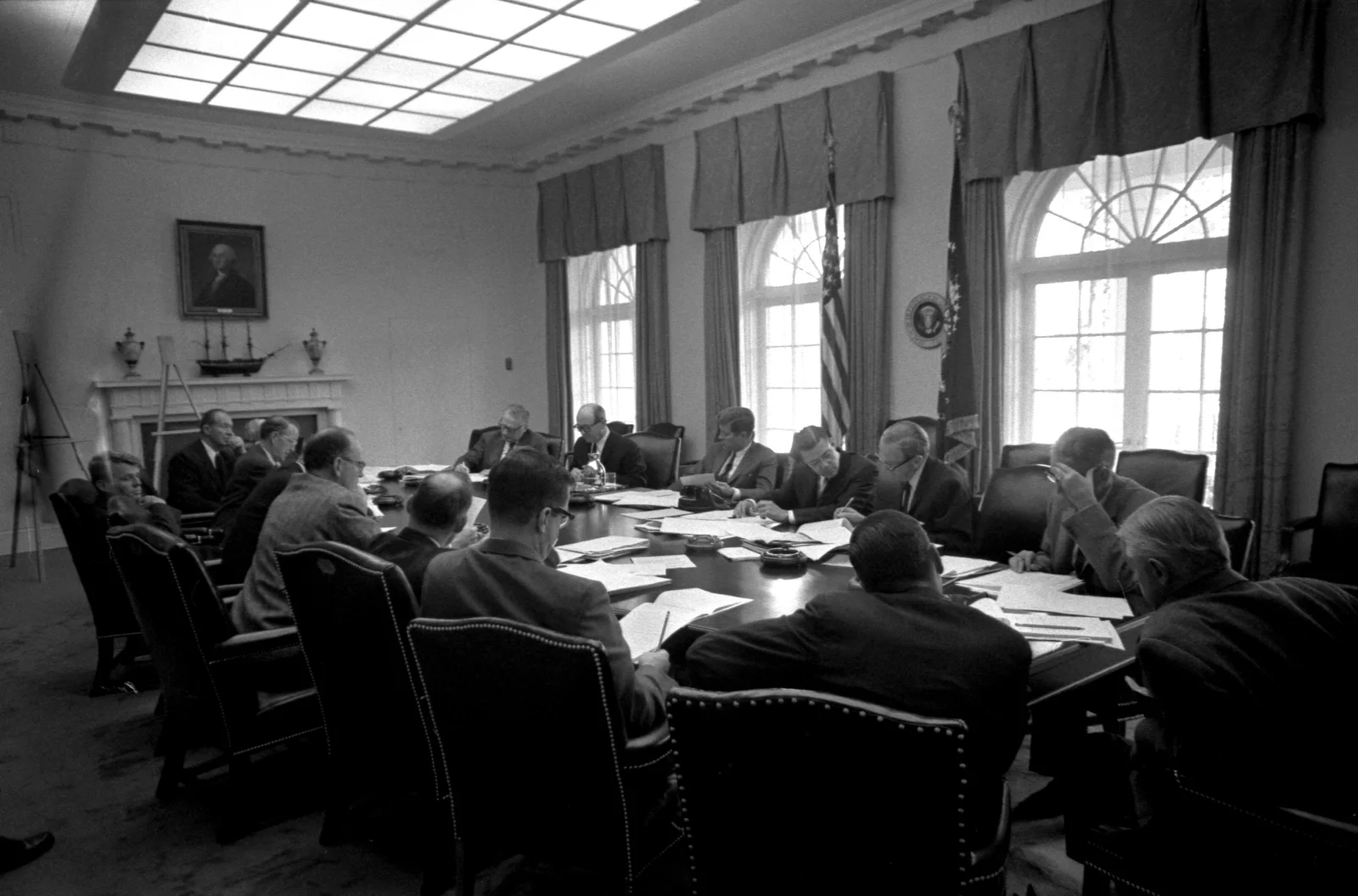


Inside the room
Advice, argument and decisions.
ExComm brought together American officials with different responsibilities. The photograph shows a meeting on 29 October, after the withdrawal announcement. The profiles below also include the Soviet, Cuban, British and UN participants.
United States
John F. Kennedy
President
Held the final authority over the American response.
Read profile ↗Soviet Union
Nikita Khrushchev
Soviet premier and Communist Party leader
Authorised the deployment and ultimately ordered its removal.
Read profile ↗Cuba
Fidel Castro
Prime Minister
Defended Cuban sovereignty while fearing an American invasion.
Read profile ↗United Kingdom
Harold Macmillan
Prime Minister
Connected Britain’s security concerns to Kennedy’s decisions.
Read profile ↗United States
Robert F. Kennedy
Attorney General
Served as a close presidential adviser and private intermediary.
Read profile ↗United States
Robert McNamara
Secretary of Defense
Managed military options while arguing over their consequences.
Read profile ↗United States
McGeorge Bundy
National Security Adviser
Coordinated advice reaching the president.
Read profile ↗United States
Dean Rusk
Secretary of State
Weighed diplomatic support, alliance cohesion and escalation.
Read profile ↗United States
John McCone
Director of Central Intelligence
Brought intelligence assessments into the policy debate.
Read profile ↗United States
Maxwell Taylor
Chairman of the Joint Chiefs of Staff
Presented the armed services’ recommendations.
Read profile ↗United States
Curtis LeMay
US Air Force Chief of Staff
Pressed for direct military action.
Read profile ↗United States
Adlai Stevenson
Ambassador to the United Nations
Combined public advocacy with negotiations in New York.
Read profile ↗United States
Llewellyn Thompson
Ambassador at large and Soviet specialist
Brought experience of Moscow to the discussions.
Read profile ↗Soviet Union
Anatoly Dobrynin
Ambassador to the United States
Carried a crucial private message between the governments.
Read profile ↗Soviet Union
Andrei Gromyko
Foreign Minister
Presented Soviet policy directly to Kennedy.
Read profile ↗Soviet Union
Anastas Mikoyan
First Deputy Premier
Negotiated with Cuba after the public settlement.
Read profile ↗Soviet Union
Issa Pliyev
Commander of Soviet forces in Cuba
Commanded a force whose weapons exceeded American knowledge.
Read profile ↗Soviet Union
Vasily Arkhipov
Submarine brigade chief of staff aboard B-59
Helped resolve a dangerous encounter at sea.
Read profile ↗Soviet Union
Valentin Savitsky
Captain of submarine B-59
Faced pursuit, exhaustion and uncertainty underwater.
Read profile ↗Cuba
Raúl Castro
Minister of the Revolutionary Armed Forces
Worked to obtain Soviet security support.
Read profile ↗Cuba
Ernesto ‘Che’ Guevara
Minister of Industries and revolutionary leader
Represented a Cuban revolutionary perspective on Soviet support.
Read profile ↗United Kingdom
Lord Home
Foreign Secretary
Directed British diplomatic work through the crisis.
Read profile ↗United Kingdom
Peter Thorneycroft
Minister of Defence
Oversaw defence policy during Thor’s final period.
Read profile ↗United Kingdom
David Ormsby-Gore
Ambassador to the United States
Linked London with the American administration.
Read profile ↗United Nations
U Thant
Acting Secretary-General
Used mediation to create room for a settlement.
Read profile ↗United States
Rudolf Anderson Jr.
US Air Force U-2 pilot
Was killed over Cuba on 27 October.
Read profile ↗United States
Charles Maultsby
US Air Force U-2 pilot
Accidentally entered Soviet airspace on 27 October.
Read profile ↗No matching people. Try a different name or select all countries.