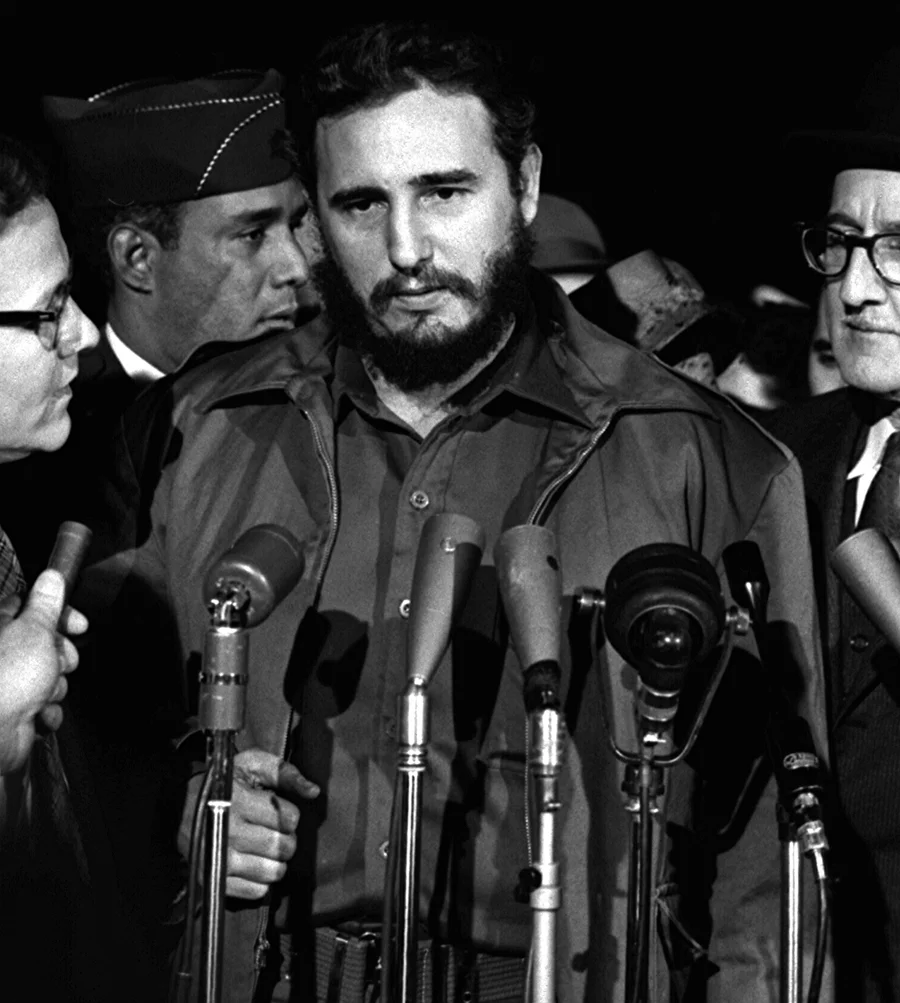


Background and position
Castro led Cuba’s revolutionary government, whose survival had already been threatened by the Bay of Pigs invasion. For Havana, Soviet assistance was tied to the fear of another attack. The missile deployment therefore had a Cuban political purpose as well as a Soviet strategic one: deterring an invasion and preserving the revolution.
Sources for this passage: [1] [2]Role in October 1962
Castro’s government accepted Soviet military support in the shadow of the Bay of Pigs invasion. In his exchanges with U Thant he rejected the quarantine and Washington’s claim to determine Cuba’s armaments. The superpower agreement did not settle all Cuban objections, leaving difficult negotiations with Moscow in November.
He challenged the assumption that Washington could decide what weapons Cuba was allowed to possess. This also shaped his resistance to international inspection on Cuban territory. U Thant’s discussions with Havana had to address sovereignty as well as the practical problem of verifying a withdrawal.
Sources for this passage: [1] [3]The invasion he feared
In his letter displayed in the JFK Library’s 26 October chronology, Castro estimated that an American attack might come within twenty-four to seventy-two hours. He distinguished a limited air attack from a full invasion. In the latter case, he urged Khrushchev not to allow the United States the opportunity to launch a nuclear first strike against the Soviet Union. The extreme recommendation was conditional on invasion; it was not an unconditional request to attack immediately.
The settlement exposed the limits of his influence over his ally. Soviet missiles could be withdrawn by agreement between Kennedy and Khrushchev even though Cuba bore the immediate risk of attack. Mikoyan’s subsequent negotiations had to address the anger and distrust that the manner of the withdrawal created.
Sources for this passage: [4] [5]Why their role matters
The public settlement was announced by Washington and Moscow without resolving Castro’s objections. Mikoyan’s subsequent talks with him dealt with trust, the remaining Soviet weapons and the consequences of withdrawal. Cuba survived as a Soviet ally, but the episode exposed how little say Havana had in the superpowers’ final arrangement.
Sources for this passage: [1] [3]