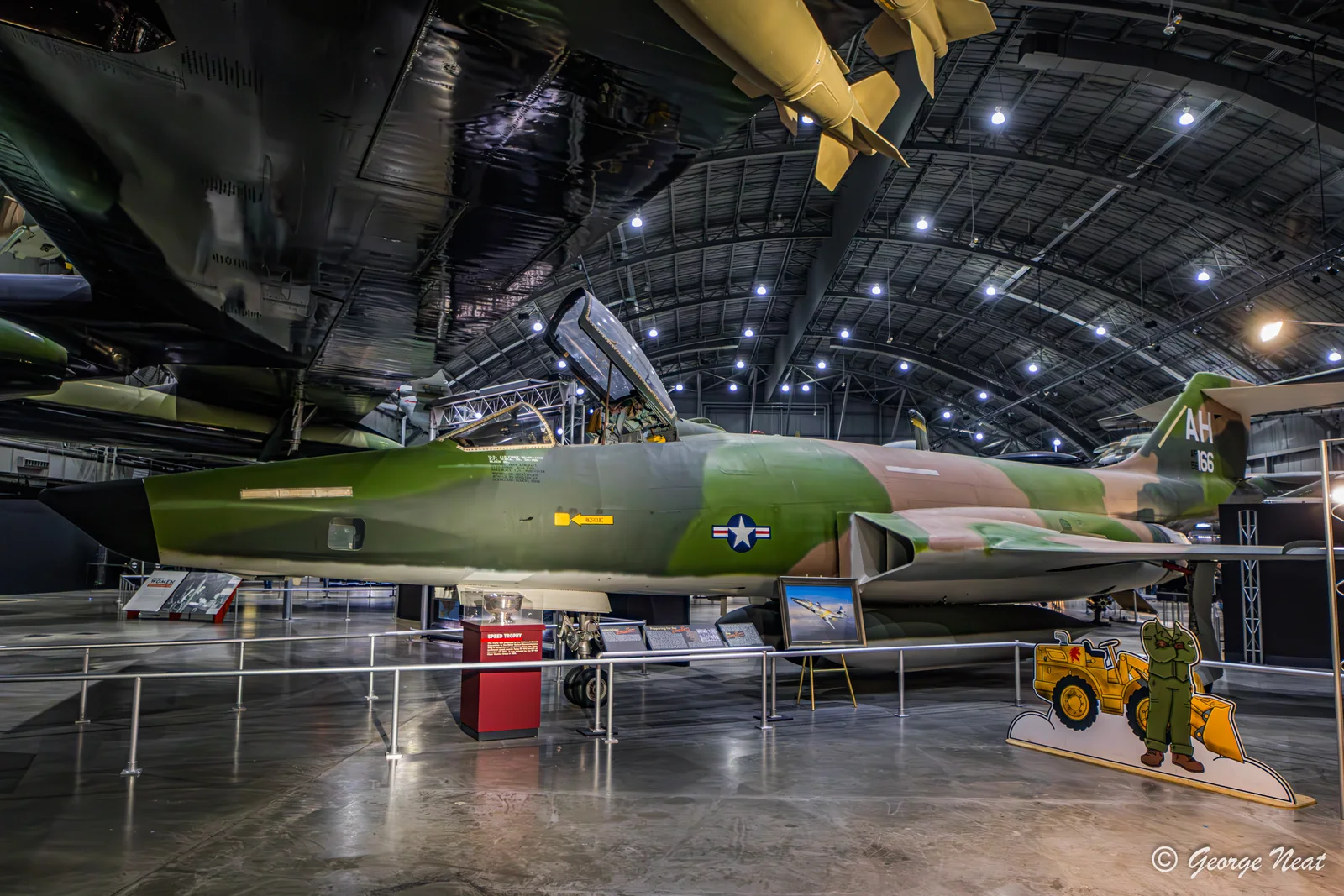

- Operator:
- US Air Force
- Type:
- Jet photographic reconnaissance aircraft
- Unit connection:
- 363rd Tactical Reconnaissance Wing
- Role:
- Low-level photographic coverage
- Engines (RF-101C):
- Two afterburning Pratt & Whitney J57s
Its place in the crisis
The RF-101 complemented the Navy’s photographic aircraft and the U-2. The 363rd Tactical Reconnaissance Wing deployed to Florida during the crisis, bringing cameras close enough to record installation details.
Reconnaissance continued after the announcement of a settlement. Images helped establish whether sites were being dismantled and equipment removed. This makes the RF-101 part of both the confrontation and the verification story.
Sources for this passage: [1] [2] [3]A reconnaissance Voodoo
The RF-101C belonged to a family that also included fighters and interceptors, but its crisis task was photographic reconnaissance. The museum’s technical notes describe a twin-engine aircraft with two afterburning Pratt & Whitney J57 engines and a maximum speed of approximately 1,000 mph. Those are type specifications, not a claim that every photographic pass was flown at that speed.
A surviving example gives the story a tangible connection: the US Air Force Museum’s RF-101C, serial 56-166, flew low-altitude missions during the crisis and helped confirm the dismantling of offensive missile sites. Its earlier participation in the 1957 Sun Run and later service in Southeast Asia are separate episodes in the same aircraft’s career.
Sources for this passage: [3]From locating sites to checking withdrawal
The RF-101’s photographs complemented the U-2 and Navy reconnaissance. Images could be compared across successive flights to identify construction, changing equipment positions and the removal of installations. That made repeated coverage important even when the broad location of a site was already known.
After 28 October, a promise of withdrawal had to be tested against observable activity. Aerial photographs and sightings of outbound shipping supplied different pieces of that evidence. Verification was a continuing operation, not something accomplished by the announcement on Radio Moscow.
Sources for this passage: [2] [4]