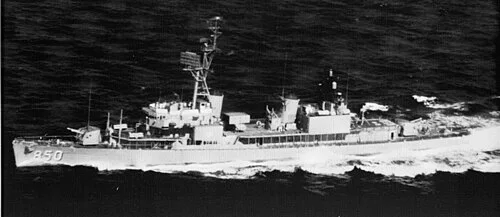
_underway_in_the_Mediterranean_Sea_1970.jpg)
_underway_in_the_Mediterranean_Sea_1970.jpg#Licensing)
- US warship:
- USS Joseph P. Kennedy Jr. (DD-850)
- Merchant vessel:
- Marucla, Lebanese-flagged freighter
- Key date:
- 26 October 1962
- Outcome:
- Searched and allowed to continue
Its place in the crisis
The destroyers Kennedy and Pierce were directed to intercept Marucla. A US Navy photograph documents the boarding party from Joseph P. Kennedy Jr. on 26 October.
Marucla was a merchant vessel, not a Soviet warship. After inspection it was allowed to proceed. The episode shows that the quarantine involved identification, orders, inspection and judgement rather than simply sinking or turning back every vessel approaching Cuba.
Sources for this passage: [1] [2] [3]What the boarding party actually did
On 26 October a boarding party led by Joseph P. Kennedy Jr.’s executive officer checked Marucla’s manifest against its bills of lading and inspected the cargo. The naval history lists goods including sulphur, paper, lathes, automotive parts and twelve trucks. One opened hold contained electrical measuring instruments.
The inspection found no prohibited offensive weapons and the freighter was released for Havana. Its Lebanese flag and merchant status matter: this was not the boarding of a Soviet warship, even though it took place within the confrontation with Moscow.
Sources for this passage: [2]Why some ships were allowed through
The proclamation identified categories of offensive military equipment subject to interdiction. It did not declare all food, fuel or civilian cargo forbidden. The tanker Bucharest had already been allowed to proceed without boarding on 25 October after surveillance of the vessel.
Identification, cargo assessment and orders from higher command were therefore central to the operation. Marucla demonstrated that the quarantine could be enforced through an actual search while still allowing a vessel to continue when its cargo did not fall within the prohibition.
Sources for this passage: [4] [5]