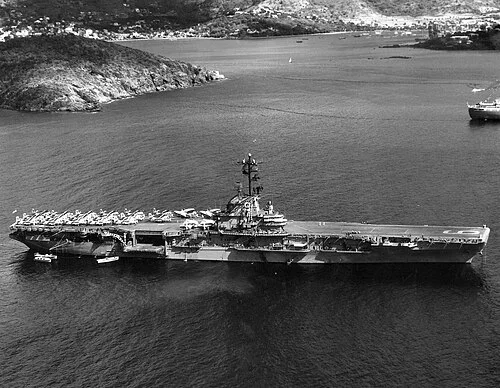
_at_Saint_Thomas%2C_U.S._Virgin_Islands%2C_14_December_1962_(NNAM.1996.488.242.047).jpg)
_at_Saint_Thomas%2C_U.S._Virgin_Islands%2C_14_December_1962_(NNAM.1996.488.242.047).jpg#Licensing)
- Navy:
- United States Navy
- 1962 designation:
- CVS-9
- Type:
- Anti-submarine aircraft carrier
- Role:
- Carrier-based surveillance and anti-submarine work
Its place in the crisis
By 1962, Essex was serving in an anti-submarine role. Its aircraft and escorts contributed to the maritime operations surrounding Cuba. A carrier was a mobile base within a larger formation, not a solitary barrier across the sea.
Essex had also been involved in the Bay of Pigs period in 1961. Those operations should be kept separate from its service during the October 1962 quarantine. Its long service history explains why photographs can show different aircraft and configurations at different dates.
Sources for this passage: [1] [2]An anti-submarine carrier’s contribution
Essex’s 1962 designation, CVS-9, identified its anti-submarine carrier role. Aircraft could search beyond the horizon of an escort ship, while destroyers investigated and maintained close contact. The carrier and screen formed an operating group with complementary tasks.
The Navy’s 25 October summary records Essex aircraft and destroyers pursuing a submarine contact. It also describes the Essex group in the operation around the tanker Bucharest. The same formation could be drawn between submarine surveillance and the immediate demands of the quarantine.
Sources for this passage: [1] [3]Surveillance did not always mean boarding
Bucharest was monitored and photographed but permitted to proceed. The operational summary records instructions to accompany it without boarding or interference, followed by the Essex group’s release back to anti-submarine work.
This is a useful corrective to a picture of a solid ring of ships stopping everything. Commanders identified vessels, assessed cargo and followed specific instructions. The political aim and the interception decision shaped how naval strength was used.
Sources for this passage: [3]