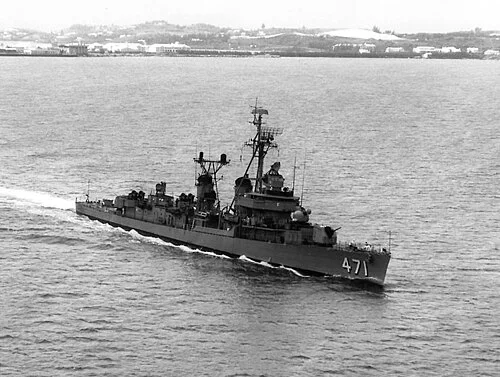
_underway_on_27_October_1964_(NH_103711).jpg)
_underway_on_27_October_1964_(NH_103711).jpg#Licensing)
- Navy:
- United States Navy
- Type:
- Destroyer
- Quarantine service:
- 25 October–5 November 1962
- Role:
- Screening, patrol and anti-submarine operations
Its place in the crisis
Beale’s official service history records its quarantine duty from 25 October to 5 November. Destroyers performed close-range tasks that could bring crews directly into contact with Soviet vessels.
Beale also appears in the records of the submarine encounters. Read those records alongside Soviet testimony: the American use of signals and the Soviet crew’s experience of being pursued were different perspectives on the same dangerous operation.
Sources for this passage: [1] [2]27 October in the destroyer’s log
Beale began the day operating with the anti-submarine carrier Randolph’s group. During the afternoon it detached with Cony and Murray to investigate a submarine contact. The log records sonar contact, manoeuvring around the contact and repeated challenges for identification.
At 16:59, the ship recorded dropping five hand grenades as a challenge. Later entries describe a Foxtrot surfacing at 20:50, aircraft making illumination and photographic runs, and Beale approaching for close photography. These are the ship’s recorded times, not a reconstructed transcript of events inside B-59.
Sources for this passage: [3]The work around a confrontation
The next day’s entries include screening the carrier, refuelling and renewed observation of the surfaced submarine. Such details show how an apparently isolated confrontation depended on a moving organisation of aircraft, destroyers and support ships.
Beale’s official history dates its quarantine service from 25 October to 5 November. The operational record therefore extends beyond the public settlement. An agreement between leaders did not instantly bring every patrol or contact with a Soviet vessel to an end.
Sources for this passage: [1] [3]