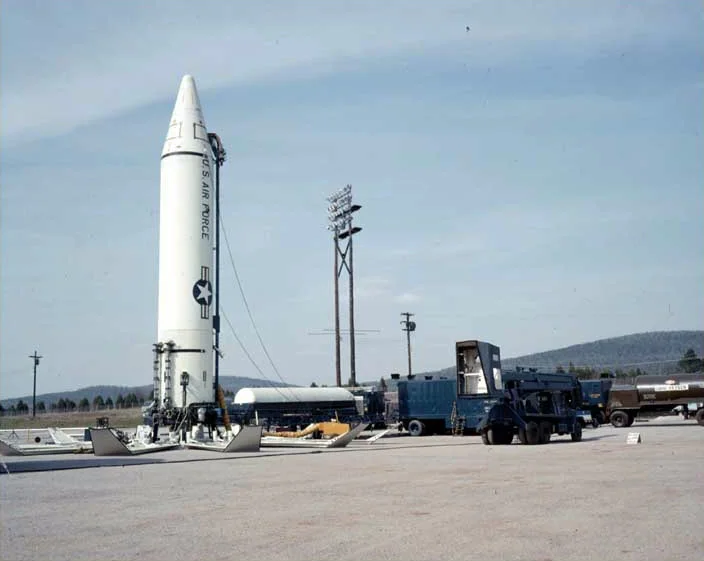


- Country:
- United States
- Type:
- Nuclear-capable ballistic missile
- Nominal range:
- 1,500 nautical miles / approximately 2,780 km
- European deployments:
- Turkey and Italy
- Propellants:
- Kerosene and liquid oxygen
Its place in the crisis
Jupiter carried a nuclear warhead and was deployed in allied European countries. Its nominal range describes the design’s capability; it does not establish a particular target or launch plan.
Khrushchev raised the missiles in Turkey during the crisis. In the private Kennedy–Dobrynin channel, Washington gave an assurance that those missiles would be removed within months, provided the understanding stayed confidential. The public exchange concentrated on Soviet withdrawal from Cuba and an American non-invasion assurance.
Keep the systems distinct: Jupiter was the missile in the Turkish bargain; Thor was Britain’s separate deployment.
Sources for this passage: [1] [2] [3] [4] [5]The missile and its launch system
Jupiter began as a US Army ballistic-missile programme, with operational responsibility subsequently assigned to the Air Force. Chrysler manufactured the missile. It used kerosene fuel and liquid oxygen, with the rocket engine accelerating the vehicle before the warhead continued along a ballistic trajectory.
A January 1957 National Security Council briefing specified a range of 1,500 nautical miles: about 2,780 kilometres or 1,726 statute miles. Stating the units matters because an unqualified “1,500 miles” produces a substantially different conversion. Range alone does not establish which target any particular crew had been assigned.
Sources for this passage: [4] [5] [1]Why Turkey and Italy mattered
The European deployments brought Soviet territory within reach of missiles based in NATO countries. By October 1962, American officials were considering alternatives, including Polaris submarines, but removing a weapon from an ally’s territory was also a political decision. A government might see withdrawal as a weakening of the American commitment to its defence.
State Department exchanges on 25–26 October show this concern directly. Officials considered how Turkey could be offered a replacement capability, while the embassy in Rome judged Italian withdrawal manageable if Italy was consulted. Thus a militarily attractive substitution could still damage the alliance if Washington appeared to bargain away another country’s security without discussion.
Sources for this passage: [6] [7]What was promised on 27 October
Robert Kennedy met Soviet ambassador Anatoly Dobrynin at the Justice Department on the evening of 27 October. Their discussion combined a warning about the danger of military action with a confidential assurance about removing the Turkish missiles. Khrushchev’s private letter of 28 October recorded a timetable of four to five months and agreed to keep the channel confidential.
The public settlement paired withdrawal from Cuba with an American non-invasion assurance. Turkey was the confidential part. Robert Kennedy’s memorandum, written on 30 October, denied a formal quid pro quo; the editorial notes and the Soviet private letter are therefore essential when reading it. The outcome cannot be explained fully by the public announcements alone.
Sources for this passage: [3] [2]Jupiter, Thor and Polaris
Jupiter in Turkey, Jupiter in Italy and Thor in Britain were separate deployments with different allied arrangements. The explicit private assurance during the final negotiations concerned Turkey. Britain’s Thor withdrawal was already being planned and should not be presented as the same concession.
Polaris offered a different basing method: missiles carried by submarines rather than exposed land installations. Proposals to replace the European Jupiters with a sea-based capability helped Washington argue that removing the missiles need not mean abandoning NATO’s nuclear protection.
Sources for this passage: [6] [8]